Not long ago, artificial intelligence in design was seen as a simple helper—good for basic tasks but far from a true creative partner. That perception has changed dramatically. Today, AI-powered tools work hand-in-hand with designers, enabling smarter, faster, and more dynamic user experiences. They offer real-time suggestions, help test bold concepts instantly, and remove the limits of time and manual effort. In fact, according to Adobe’s 2024 report, over 60% of designers are already incorporating AI tools into their daily workflow.
This shift is redefining the way we think about creativity, collaboration, and the design process itself.
Is AI Replacing Creativity?
One of the most common questions in the creative industry is: Will AI take over creativity?
The answer is a clear no. AI is not here to replace the imagination, emotional depth, and storytelling that only humans can bring. Think of AI as the modern equivalent of inventing the paintbrush—it doesn’t create art on its own, but it gives artists new ways to express their ideas.
In UI/UX, AI handles repetitive work, interprets complex datasets, and offers intelligent design suggestions. But the soul of the design—the message, tone, and emotional connection—still comes from the human designer. AI provides the toolkit; you provide the vision.
How AI Supports Designers
1. Rapid Ideation & Prototyping
AI can transform a rough idea into a wireframe, layout, or mockup within minutes, helping overcome creative blocks and jump-starting the design process.
2. Generating User Flows & Personas
Instead of building them from scratch, designers can use AI to create initial drafts of user journeys and personas, then refine them based on insights.
3. Intelligent Layout Suggestions
By identifying design patterns, AI can recommend layout adjustments or arrangement tweaks to inspire innovative solutions.
4. Personalization at Scale
AI-driven systems adapt interfaces in real time based on user behavior, making each experience unique and relevant.
5. Automating Tedious Work
Tasks like resizing elements, color corrections, and image editing can be handled automatically, freeing up more time for creative problem-solving.
6. Data-Driven Insights
AI can analyze user analytics, detect behavioral trends, and help designers make more informed decisions.
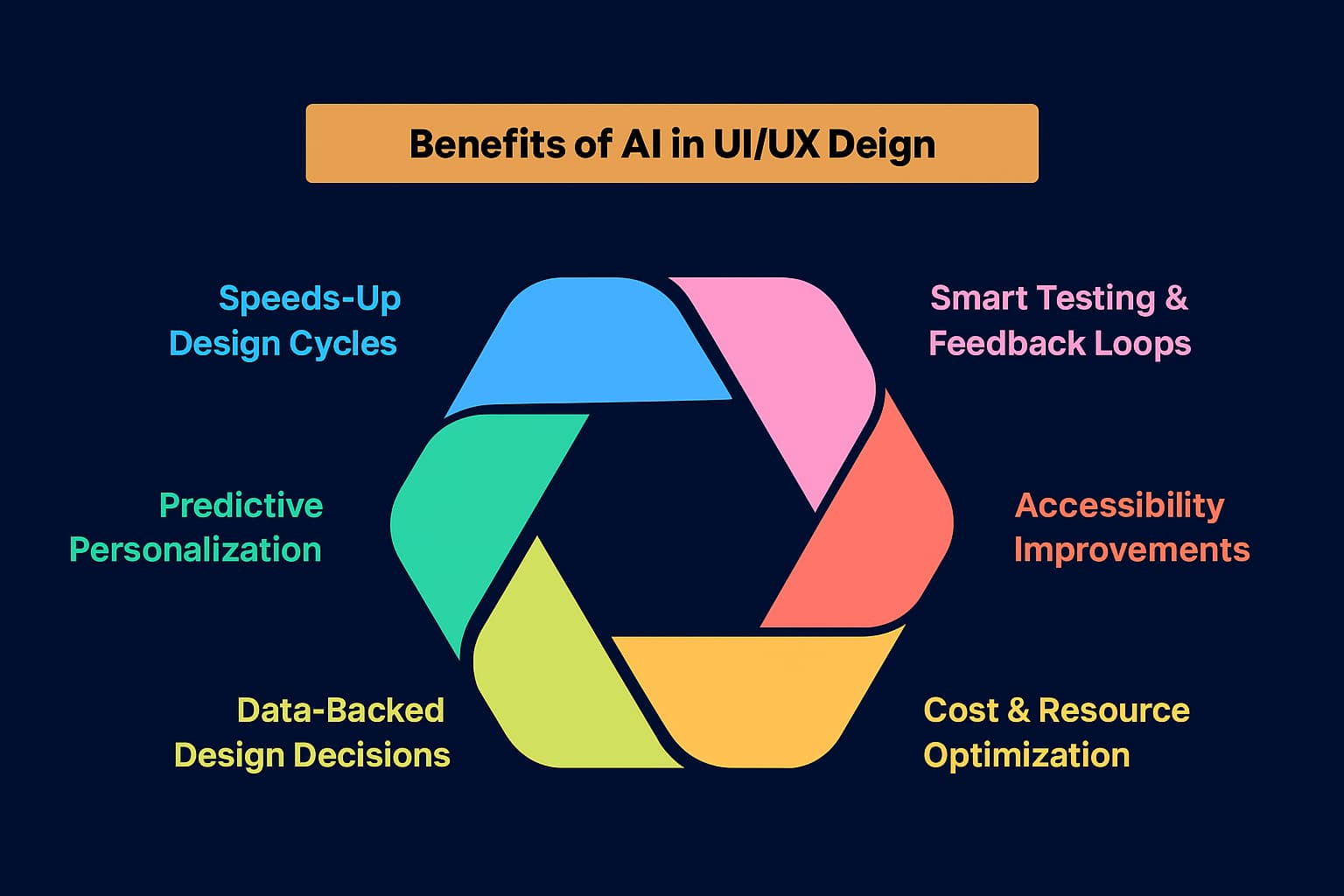
Key Benefits of AI in UI/UX Design
Faster Design Cycles
Tools like Uizard and Figma AI can turn text prompts into functional UI components, cutting down the time needed for design iterations.
Smarter Testing & Feedback
Automated heatmaps, A/B testing, and behavioral analytics pinpoint problem areas and suggest optimizations—removing personal bias from the equation.
Predictive Personalization
By studying past user actions, AI can anticipate needs and adjust navigation, layouts, and content accordingly.
Enhanced Accessibility
AI identifies contrast issues, generates alt text automatically, and offers voice navigation—ensuring compliance with accessibility standards and making digital products more inclusive.
Better Decision-Making with Data
Big data analysis reveals conversion trends, user drop-off points, and micro-interaction effectiveness, guiding design choices with evidence.
Resource Optimization
By automating repetitive tasks, AI reduces the need for large design teams, boosting efficiency and lowering costs.
The Road Ahead: AI and the Future of UI/UX
The next generation of AI in UI/UX will be proactive, immersive, and deeply human-centered. Instead of simply reacting to user actions, AI will anticipate needs—delivering helpful tools, resources, or content before users even think to ask.
With AR, VR, and mixed reality devices becoming mainstream, design will expand beyond flat screens into 3D environments. AI will help build natural interactions, spatial navigation, and adaptive interfaces that blend digital and physical worlds seamlessly.
But this progress must come with responsibility. Because AI learns from personal data, designers must ensure transparency, fairness, and inclusivity. Avoiding bias, respecting cultural diversity, and following ethical guidelines will be critical to building trust.
Final Takeaway
Artificial intelligence is not replacing creativity—it’s amplifying it. By removing repetitive work, speeding up cycles, and unlocking new possibilities, AI empowers designers to focus on crafting experiences that are intuitive, emotional, and highly personalized.
The future will bring voice-based interactions that adapt in real time, generative layouts, and emotionally aware systems that connect with users on a deeper level. The designers who thrive will be those who embrace AI as a collaborator—balancing data-driven insights with human creativity.
If you’re looking to create innovative AI-powered UI/UX solutions or tools that make designers’ work easier, partnering with an experienced AI/ML services company can be the first step. A proof of concept today could be the breakthrough product of tomorrow.